
When homeowners begin designing a luxury italian kitchen, they often seek the expertise of Modenese Bespoke for custom kitchen planning that merges Mediterranean aesthetics with rigorous spatial engineering. Proper interior design requires exact measurements to ensure that heavy materials and high-heat furniture function safely together. Balancing thick marble surfaces with induction cooktops demands strict adherence to international building codes and ergonomic guidelines.
European Cabinetry Standards and the 32mm System
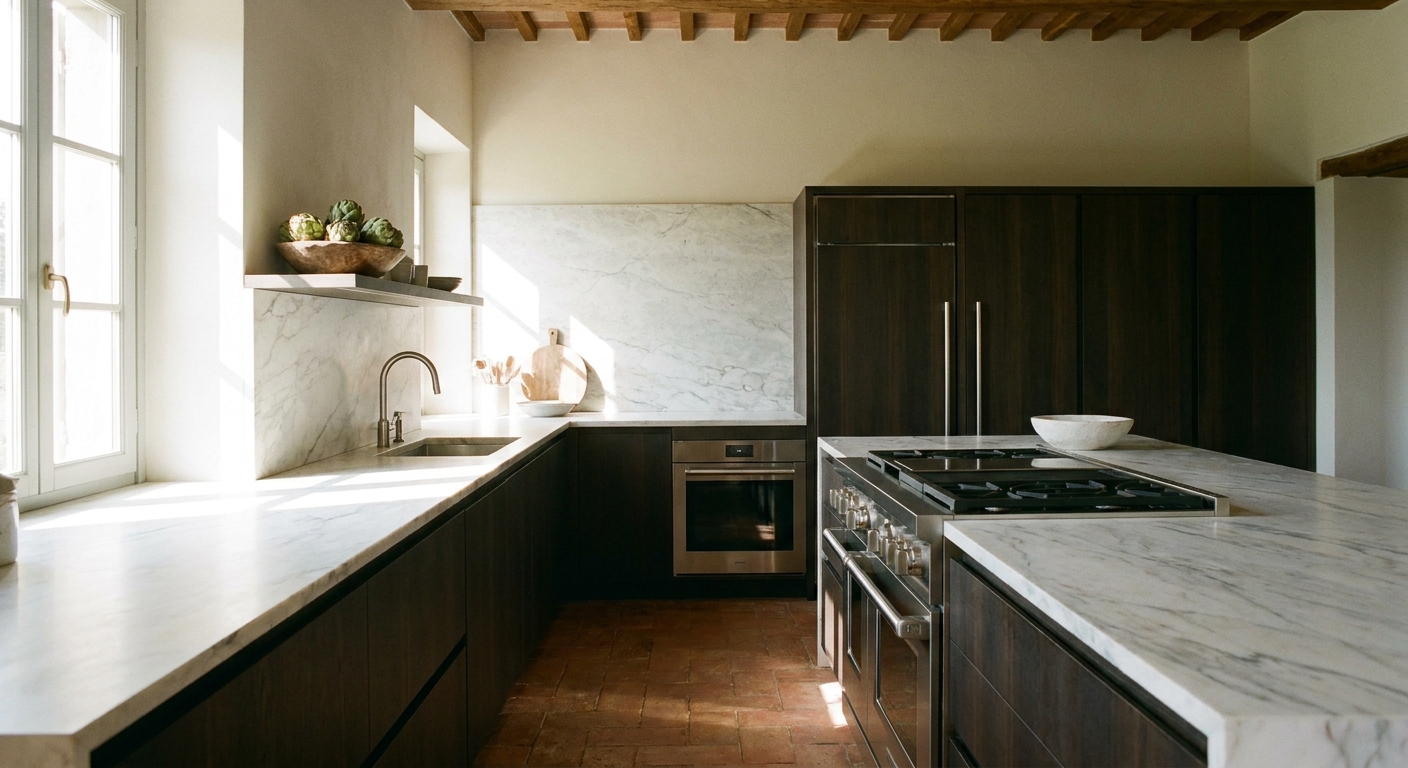
European cabinetry standards rely on the System 32 manufacturing principle, which employs columns of five-millimeter holes spaced at thirty-two-millimeter intervals to ensure precise modular alignment, allowing frameless structural carcasses to safely support heavy natural stone worktops and seamlessly integrate modern cooking appliances without compromising internal storage dimensions.
The foundation of modern European kitchen design traces back to the 1926 Frankfurt kitchen, which introduced the concept of built-in, unified workspaces. Today, the System 32 cabinetmaking standard, originating from the German Institute for Standardization under DIN 68881, mandates that manufacturers drill five-millimeter diameter holes at exactly thirty-two-millimeter intervals. Standardized spacing allows designers to calculate exact load-bearing capacities for base cabinets. Frameless base cabinets must support the immense dead weight of natural stone while maintaining perfectly level surfaces for appliance installation.
Modularity and Structural Support
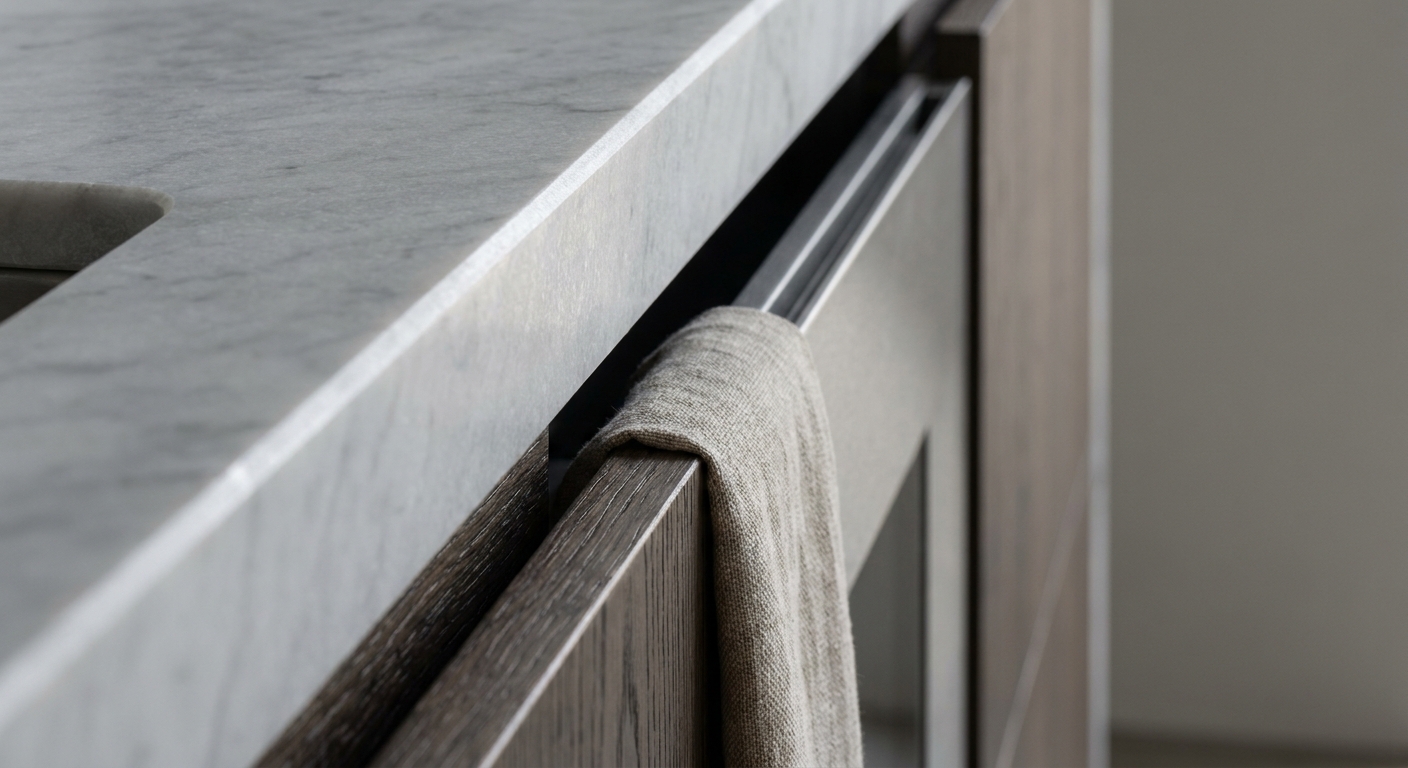
Frameless cabinets maximize interior volume by eliminating the front face frame common in North American construction. Installers must verify that the distance from the first row of hardware holes to the front edge of the cabinet measures exactly thirty-seven millimeters. Maintaining precise dimensions ensures that cabinet doors align perfectly flush with the adjacent appliance faces. Installers use specialized leveling legs to compensate for uneven floors, ensuring that the continuous stone worktop does not crack under uneven stress.
Natural Stone Worktop Specifications and Overhang Limits
Natural stone worktop specifications dictate strict overhang limits based on material thickness, requiring designers to restrict unsupported spans to six inches for twenty-millimeter slabs and ten inches for thirty-millimeter slabs to prevent structural failure under the weight of daily culinary activities.
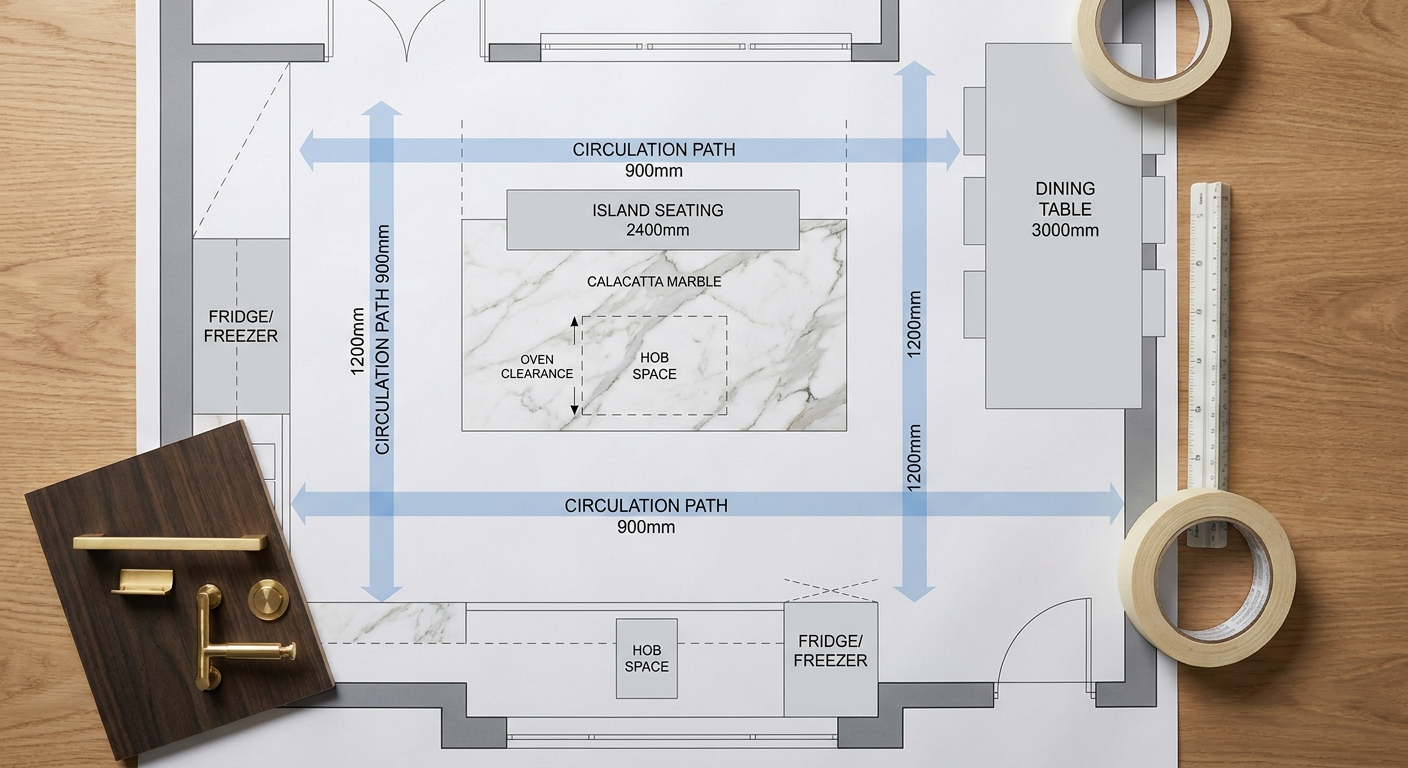
The Natural Stone Institute publishes the Dimension Stone Design Manual, which serves as the authoritative guide for stone installation. According to the Natural Stone Institute’s Dimension Stone Design Manual, twenty-millimeter thick natural stone worktops permit a maximum unsupported overhang of six inches, whereas thirty-millimeter slabs allow up to ten inches of unsupported span before requiring steel sub-frame reinforcement. Installers working with twenty-millimeter thick granite or marble must ensure that the wooden base cabinets provide continuous support across the entire span. Thirty-millimeter stone slabs offer greater tensile strength but still require careful weight distribution calculations by structural engineers, especially around sink cutouts and cooktop openings.
Thermal Conductivity and Heat Protection
Natural stone possesses specific thermal conductivity properties that affect how the material interacts with high-heat appliances. Dense materials like granite and quartzite transfer heat differently than porous limestone. Stone fabricators must leave a nominal one-eighth-inch expansion joint between the stone units and other materials, such as cabinetry or gypsum wallboard, to accommodate thermal expansion. Proper expansion spacing prevents the natural stone from cracking when exposed to the radiant heat generated by adjacent ovens or dishwashers.
Appliance Clearances and the Kitchen Work Triangle
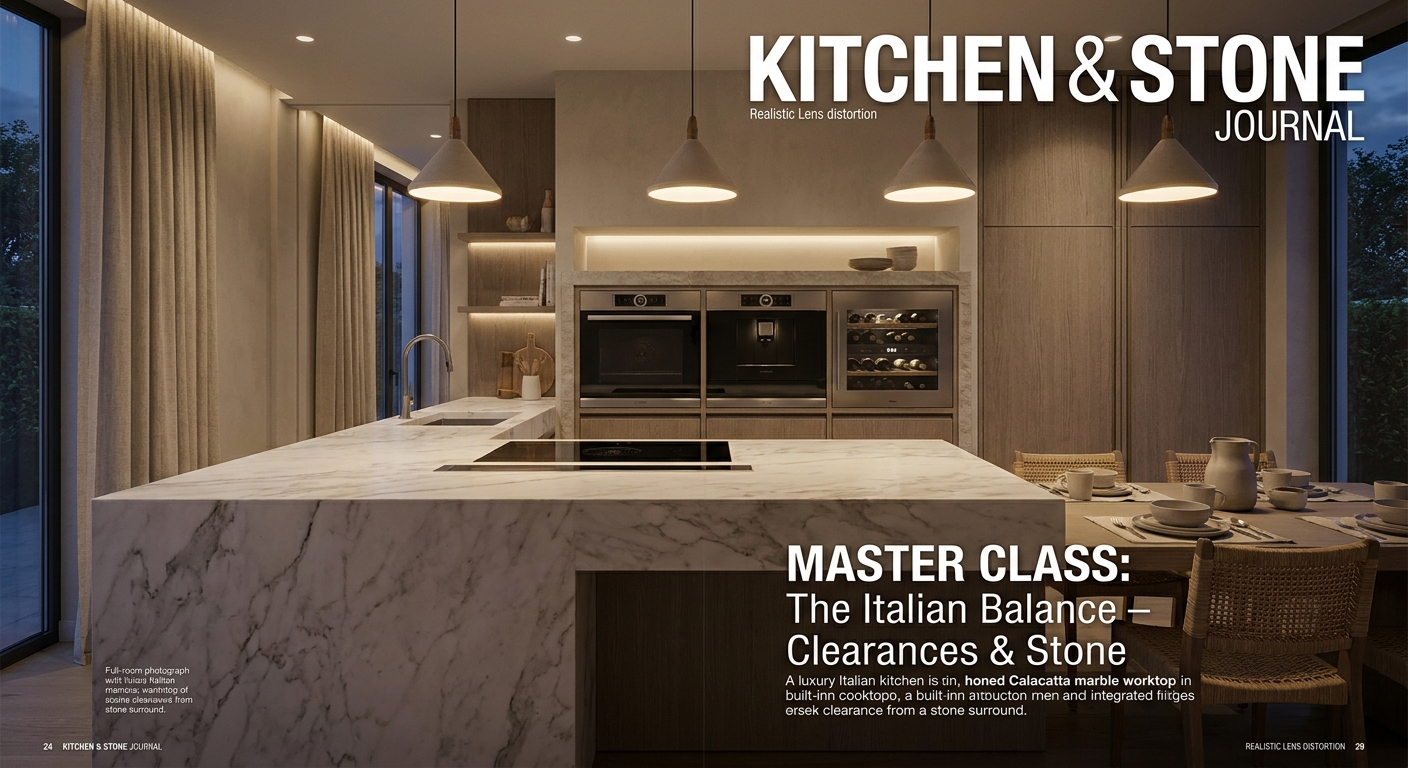
Appliance clearances and the kitchen work triangle require spatial configurations where the sum of the three primary travel distances measures no more than twenty-six feet, ensuring that cooking, cleaning, and refrigeration zones remain safely accessible without intersecting island worktops by more than twelve inches.
The National Kitchen and Bath Association establishes comprehensive safety rules for residential kitchens. The National Kitchen and Bath Association’s Kitchen and Bathroom Planning Guidelines mandate a minimum work aisle clearance of forty-two inches for single-cook kitchens and forty-eight inches for multiple-cook kitchens between opposing stone worktops to ensure safe appliance door operation. Kitchen planners must measure each triangle leg from the center-front of the sink, cooktop, and refrigerator. Maintaining proper clearance distances prevents traffic bottlenecks and ensures that multiple users can navigate the kitchen space safely.
Induction Cooktop Safety Distances
Induction cooktops require specific vertical and horizontal clearances to combustible materials to comply with fire safety codes established by organizations like the National Fire Protection Association. While induction technology transfers electromagnetic energy directly to magnetic cookware rather than heating the surrounding air, the cookware itself generates significant radiant heat. The Underwriters Laboratories standard UL 858 for household electric ranges requires installers to maintain a minimum vertical clearance of thirty inches between an induction cooktop surface and any unprotected combustible wood cabinetry located directly above the appliance. Furthermore, kitchen designers must maintain a minimum vertical clearance of eighteen inches from the stone countertop to the bottom of the upper cabinets on either side of the cooking zone.
| Appliance or Feature | Minimum Clearance Requirement | Governing Standard |
|---|---|---|
| Work Triangle Total Distance | Maximum 26 feet (7.9 meters) | NKBA Guidelines |
| Work Triangle Single Leg | 4 feet to 9 feet | NKBA Guidelines |
| 20mm Stone Overhang | Maximum 6 inches unsupported | Dimension Stone Design Manual |
| 30mm Stone Overhang | Maximum 10 inches unsupported | Dimension Stone Design Manual |
| Induction Cooktop Vertical Clearance | 30 inches to combustible hood | UL 858 / International Residential Code |
Related reading on this site
Readers comparing planning rules can also review Kitchen design – Best Joinery Service Dubai for adjacent context on the same site.
Material and proportion decisions connect closely with Exclusive Kitchen & Pantry in Dubai, which gives readers another local reference point.
Project research can continue with Top 5 Cool Ideas to Upgrade Your Kitchen when the next question concerns a neighboring design topic.


